Protect your investment!
So you did it! What has probably cost you tens of thousands of pounds has culminated in you being awarded a small plastic book that says you’re a commercial pilot. So what happens now? Well, you’ll just get a job, right? Wrong! The assessment phase that really counts is just about to begin, and that means being successful with an application and assessment to an airline.
In buoyant times, with demand for pilots high, you arguably stand a better chance of getting that dream job on the flight deck. But when the market takes a downturn, it’s vitally important to be ready for an application and assessment, and that means not leaving it until the last minute. In this article, we’re going to look at the basic processes involved in applying to, and then passing, an airline assessment process.
“However, when the market takes a downturn, it is vitally important to be ready for an application and assessment and that means not leaving it until the last minute!”
The Application
Far from being a “tick box” exercise, your application to an airline forms a crucial part of the selection phase. Whether you’re applying to a major international carrier, a low-cost operator, or a small airline flying float planes on the other side of the world, you’ll be competing against what could be thousands of other pilots. Some may have more experience than you, and may even be type rated, all applying for the same position. Your application often forms part of your assessment!
The application phase will usually consist of some form filling to check that you meet the entry requirements, attaching your CV, potentially a cover letter, and answering some “essay questions”. Let’s look at each of these in turn.
Creating a Pilot CV
A pilot CV is your chance to sell all of your experience to date in a way that indicates your suitability for the role of a commercial pilot, and your suitability for that company. It’s simply not enough to have a “one size fits all” templated CV. Beware of companies that “write your CV” for you. Each pilot CV needs to be carefully tailored towards each airline you’re applying to.
Do you meet their entry requirements? When an airline opens recruitment, it could receive thousands of pilots’ CVs. It’s therefore vitally important that your CV first and foremost indicates that you have the necessary qualifications to apply to that airline. Make it clear. If it’s difficult to discern that information from your CV, it may not get passed to the “shortlisted” pile.
Introduce pilot competencies! When describing your experience to date, make sure you’re indicating the skills and qualities in each of your roles in a way that links to being a commercial pilot and a commercial asset. Evidencing competencies throughout your career history is essential. Competencies include things like leadership, teamwork and communication.
One page CVs? It really doesn’t matter, and you shouldn’t get too hung up on it. These days most CVs are viewed electronically and scrolled through. Just make sure everything on your CV is concise and relevant to your experience. It would be very hard for a military pilot with 20 years’ experience in multiple roles to condense that into one page. If you’ve just completed your flying training, make sure you include a reference to it.
Hobbies and interests. Think about integrating aspects of any hobbies that link to competencies an airline would like to see in its pilots and employees, such as teamwork.
Our Academy Application course shows you how to build a standout pilot CV of your own.
Creating a Pilot Cover Letter
A pilot covering letter is your chance to evidence to the airline that you’re the right fit for them.
Demonstrate your motivation for joining that airline. You should be able to effectively demonstrate why you’re applying for the role.
Don’t overdo the content. Briefly summarise the experience and competencies that would make you an asset to the role, and indicate why you’d be a commercial asset to the airline. Keep your covering letter concise and to the point. Your CV is the place for most of the detail.
Our Academy Application course covers exactly how to craft an impactful covering letter, or see our covering letter services for one-to-one support.
Airline Essay Questions
Some airlines will ask you to answer questions as part of the application process. These “essay questions” are designed to check your motivation for wanting to work for the airline, and to let you demonstrate the key competencies that would make you an asset – and not just in the role of pilot. They often ask something along the lines of: “In no more than 300 words, tell us why you believe you would be an asset to our team and what skills and qualities you will bring to the role.”
Take your time and do your research! You must give these essay questions the due diligence and time they warrant. In all cases, make sure you research the airline you’re applying to thoroughly. No matter what your experience level, nobody owes you an interview. You must earn it!
Introduce competencies! As with a CV and covering letter, you must introduce key competencies that back up your answer.
Our Academy Application course walks you through exactly how to approach application questions, so you evidence the right things in the right way.

The Airline Assessment
Once you’re through the application phase, it’s time for the assessment. Most airline pilot assessments follow a broadly similar format. Some will require you to undergo remote assessments online; some will complete the entire process in person. You can usually expect an assessment phase to comprise all, or most, of the following: psychometric and aptitude testing, a group exercise, an interview, and a simulator assessment.
Whatever’s involved in your assessment, it’s crucial that you make time to prepare. This may be your only opportunity to gain employment with that company, and you should treat each and every airline interview as if it’s your dream job. Do not use any assessment as “practice” for another airline!
Documentation. You will almost certainly be given a list of required documentation to bring with you. If not, then as an absolute minimum, you should have the following with you:
- Licence
- Medical certificate
- Logbook
- Passport
- Personal details
Make sure you read the documentation from the airline regarding your assessment extremely carefully.
Personal Appearance and dress code. It’s essential that your personal appearance demonstrates the high standards you’d uphold as a pilot, and as a potential future representative of that company. Make sure you’re smartly dressed and that your shoes are polished.
Pilot Psychometric & Aptitude Testing
Pilot Psychometric Tests and Aptitude Testing.
Everybody has a different innate ability in these types of test. Common psychometric tests include inductive, diagrammatic, verbal and numerical reasoning. The only way to prepare is to practise! You must become adept and familiar with these tests ahead of any assessment, which includes making sure your basic maths and physics are up to speed.
But practise strategically. It’s well worth working through practice material, but be aware that the real test on the day may differ from the practice versions you’ve been using. There’s a risk that over-practising a test that only emulates the real thing means your brain starts recognising patterns that simply aren’t there on the day. So do practise, but practise smart, not endlessly. Identify your weak areas, focus on consistency, and build genuine familiarity rather than rehearsing one specific format.
Aptitude tests do exactly what they say on the tin: they assess your aptitude for the role of a commercial pilot. These will usually involve elements testing your hand-eye coordination, spatial awareness, memory and reaction time. There’s a wealth of practice material available online covering the types of test commonly used.
Airline Pilot Interviews
The interview stage is your chance to shine and evidence to the recruitment team why you’d be an asset to their company. You can usually expect to be interviewed by more than one interviewer, although not always. Whatever the case, be prepared for both non-technical and technical questions.
Be yourself. The interviewers want to get to know the real you, not a rehearsed version, so it’s important to relax as much as you can and be yourself.
Do NOT rehearse answers! Preparing is not the same as rehearsing. Learning easy-to-use frameworks can make a real difference to your performance.
Demonstrate your motivation! If you can’t demonstrate your motivation for the role and your desire to work for that airline, it’s unlikely you’ll be successful at interview. Do your research and really think about why you’re applying to that company.
Competency-based questions. In a modern airline pilot interview, there’s usually significant emphasis on competency-based questions. It’s essential that you’re prepared to evidence competencies for the role. Competencies include things like leadership, teamwork and communication. Simply stating that you have “good communication skills” isn’t enough. You must be able to evidence to the interviewers why you have them.
Technical questions. Although some interviews don’t include technical questions, you should be prepared to answer them. If you’re a low-hours or non-type-rated pilot, make sure your general ATPL knowledge is up to speed. If you’re type rated, make sure your technical knowledge of that type is excellent too. That airline may not fly that particular type, but one of the interview team may have previously flown it and if you can’t demonstrate sound knowledge, what does that say about your professional standards?
Industry knowledge. You should also be able to demonstrate good industry knowledge, and knowledge of the company you’re applying to.
Check out our Academy Interview and Group Exercise Online Course to start your preparation.
Airline Pilot Group Exercises
Group exercises form a key part of many airline assessments. They’re designed to see how you interact in a group or team setting when faced with a fictitious problem. During a group exercise, you can expect to have to resolve a potentially complex situation, and one where multiple outcomes might be appropriate.
It’s not a competition! You’ll likely face this exercise with other candidates you may not have met before, who may have vastly different backgrounds to you. Don’t assume anything in a group exercise. It’s very difficult for people not to be the intrinsic characters they are, and you should give this careful thought before you go in. You’re more likely to be successful if you support the other team members, rather than competing against them.
Being the leader? Don’t be afraid to take a prominent role. That doesn’t mean you have to be “the leader”.
Work collaboratively. Try to work collaboratively during the group exercise to find an appropriate resolution to the problem you’re faced with. These exercises embrace many of the key skills and competencies pilots use every day at work, when interacting with the various teams involved in the multifaceted role of a pilot. That’s why they usually form a fundamental part of an airline assessment.
To prepare online at your own pace, our Academy Interview & Group Exercise course covers everything in depth. For a fully immersive experience, our Assessment Preparation Group Course gives you a full day of preparation including assessed and de-briefed practical exercises.
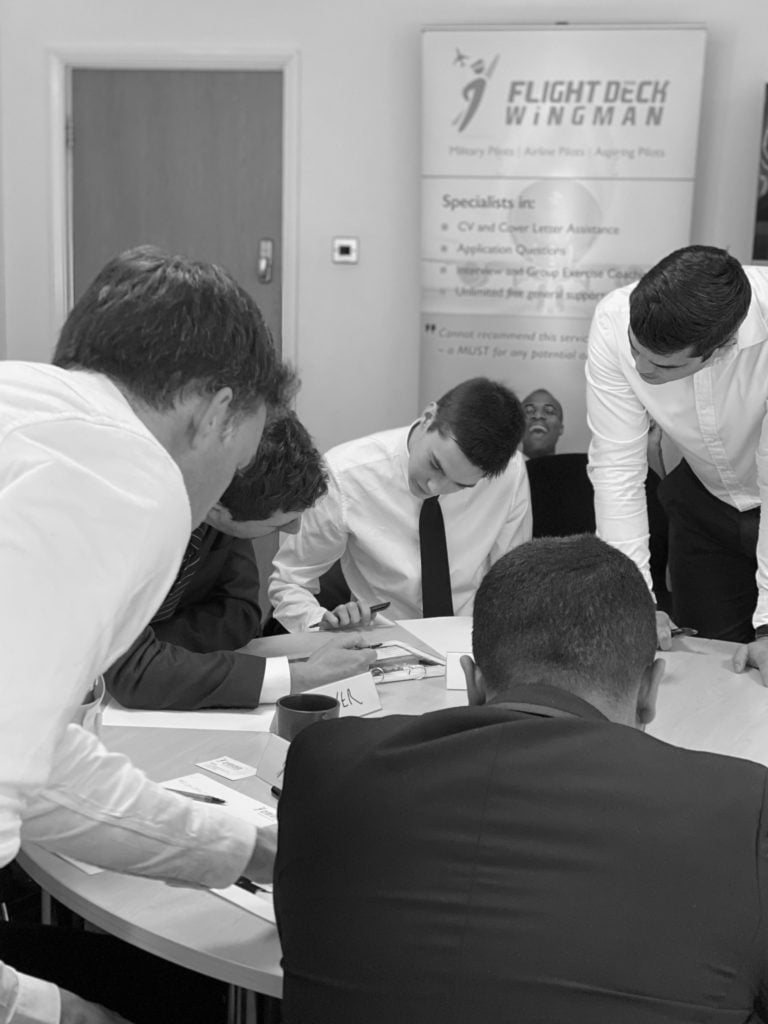
A Flight Deck Wingman Assessment Preparation Group Course Course in progress in 2020.
Simulator Assessment
Simulator assessments can be one of the more nerve-wracking aspects of the process. If you’ve made it through to the simulator, the chances are you’ve impressed in all the other areas. That said, don’t assume an average performance will mean success.
Don’t worry if you’re not familiar with the type of aircraft you’re being assessed on. This is absolutely not the most important thing, and the assessors won’t expect you to fly it as well as a seasoned type-rated pilot. You’ll be assessed for smoothness, accuracy and overall improvement throughout the detail. Your non-technical skills are also likely to be assessed, and you’ll often find yourself teamed up with another candidate.
Practise “raw data” flying! Most simulator flying doesn’t represent day-to-day flying, in that during a simulator assessment you’re likely to be asked to fly raw data SIDs and STARs, most probably without the use of full automation. Make sure you take some time to practise this type of flying, joining holds and so on, well ahead of any simulator assessment.
Know the datums! The airline is also likely to send you documentation ahead of the assessment, including pitch and power settings, profiles and checklists. Make sure you know these parameters inside out. What would it say to the assessor if you didn’t know the settings, having had them in advance?
Booking simulator time. While it might help your confidence and general exposure to book some simulator time, don’t feel you need a full flight simulator to prepare. And remember: it’s usually the non-technical competencies, not manual flying, that catch candidates out. Our Simulator Assessment Coaching focuses on exactly those competencies and how to evidence them, which is where preparation time makes the biggest difference.
The Outcome
Whatever the outcome, positive or negative, always aim to learn something from an assessment process. You never know when you might need it in future. If it hasn’t been a positive result, reflect carefully on the areas where you think you could have done better, or where you may have fallen short. Very often, the reason comes down to preparation. Many of the pilots who come to Flight Deck Wingman have previously been unsuccessful with an application or assessment elsewhere, and it’s rarely about ability.
“I qualified four years ago as a commercial pilot with the intention of working for an Airline. Having been through many Airline interviews during this time, I always received the dreaded “... you have not been successful email.”

I was introduced to Andrew at Flight Deck Wingman who was fantastic and within ten minutes of our Skype session he had worked out where I had been going wrong all this time! Flight Deck Wingman’s interview techniques along with the genuine enthusiasm, had given me the confidence I required to gain my dream job working for Ryanair.

Flight Deck Wingman always put my interests first, made time for me and were great with communication. I would thoroughly recommend  Flight Deck Wingman to anyone looking for interview preparation. The only regret I do have was I wish I met Andrew and Flight Deck Wingman earlier during my flying career!” Sachin Varia
Am I Prepared?
How Do I Know If I’m Ready? That’s a great question, and one worth asking yourself. If you’d like to test your readiness, consider taking a Mock Interview with us. You’ll receive an airline-style interview and psychometric testing, plus in-depth written or verbal feedback on your performance, which is invaluable in identifying your weaker areas. It’s the same skills test used by some UK flight schools to assess their students, so it’s a genuine gauge of your readiness for an airline assessment.
Get Yourself a Wingman!
How Can You Prepare?
Whether you’re an aspiring, military, or experienced airline pilot, please get in touch if you’d like some help with your application and assessment.
Our Wingman Academy courses cover the application and interview and group exercise stages in depth, all online and at your own pace. If you’d prefer personal input, we also offer one-to-one coaching across every stage. Every session is human-led, delivered personally by Wingman Andrew, a current airline pilot, former military fast-jet pilot and experienced recruiter who’s sat on both sides of the table.
Your licence has cost you a great deal to gain. Preparation for the stage that ultimately decides whether you get the job deserves the same seriousness you gave your training.
Editors note: I’ve been asked many times why I formed Flight Deck Wingman. Back in 2006 I had just left the military and attended my first airline assessment. I failed it. Why? I failed the psychometric testing stage – I didn’t even know that was part of the process. I was a front-line fast-jet pilot and I assumed I’d be fine (not even arrogantly!), but I hadn’t adequately prepared. If I’d had an awareness of what the process involved, my career path might have been very different. Sure, things have worked out for me. But having moved on from my first airline job after 10 years there due to job security worries, I had to start at the bottom of another seniority list again, and that has hurt my career earning potential significantly. I wanted to make sure others didn’t make the same errors, so Flight Deck Wingman was born!


